
Activated Carbon Manufacturer in India: A Bulk Buyer’s Guide
In short: buying activated carbon in bulk is not like buying a commodity off a shelf. The same word, “activated carbon”, covers products that behave very differently in a filter, a reactor or a gold circuit. This guide walks you through what to check when you choose an activated carbon manufacturer in India, from raw material and grade to testing, packing, price and delivery, so your first bulk order is also the right one.
Why India has become a sourcing hub for activated carbon
Walk into a water treatment plant in Dubai, a sugar refinery in Maharashtra or an edible oil unit in Gujarat, and there is a good chance the carbon in the tanks was made in India. There are solid reasons for that. India has access to all three major raw materials for activated carbon: coal, coconut shell and wood. It has decades of experience with steam activation. And it sits on short sea routes to the Gulf, East Africa and South-East Asia.
For a buyer, this means choice. It also means you need to separate producers from traders, and grades that look similar on paper from grades that actually perform the same in your process. That is what the rest of this guide is about.
Manufacturer, exporter or trader: why the difference matters
Many companies call themselves an activated carbon supplier. Some make the carbon. Some buy it from several plants and repack it. Both can be legitimate, but they give you very different control over quality.
- A manufacturer controls the raw material, the activation step, the crushing and sieving, and the final testing. If a batch drifts, they can find out why.
- A trader may give you a good price on one order, but the next container can come from a different plant with a different raw material, and your filter will notice even if the label looks the same.
- An exporter with its own production gives you both: the factory’s control and a team that understands export documents, packing and shipping.
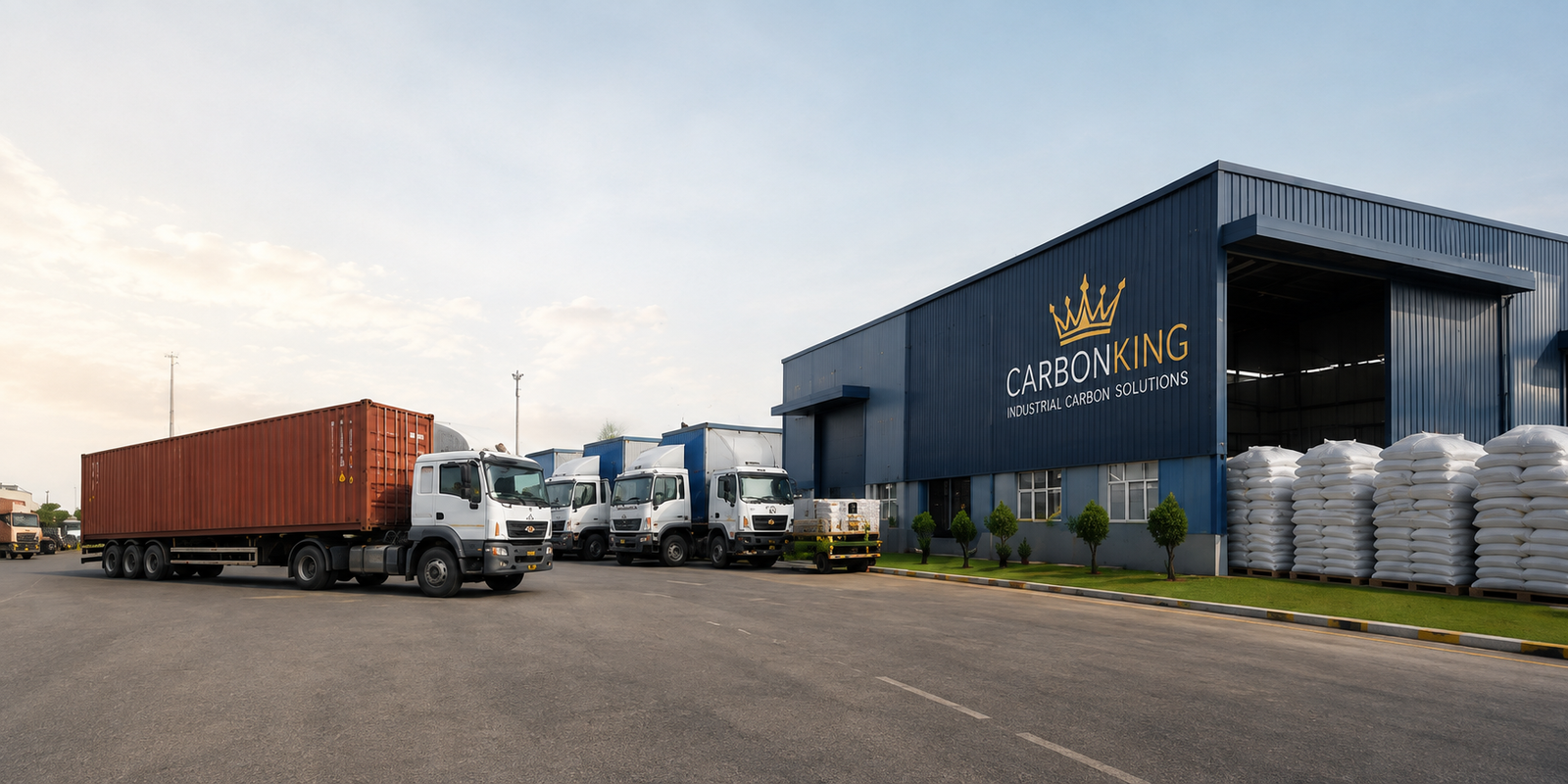
Carbon King falls in the last group. We have been in carbon since 1994, with 30,000 MT of annual capacity and buyers in more than 18 countries. Our registered office and principal place of business is in Rourkela, Odisha, our India office is in Kolkata, West Bengal, and our international marketing headquarters is in Dubai Silicon Oasis, UAE. You can read more on our why choose Carbon King page.
Step 1: Start with the job, not the product name
The most common mistake in a first enquiry is to ask for “activated carbon, best quality, best price”. A good manufacturer will reply with questions, because the right answer depends on what the carbon has to do. Before you send an enquiry, write down:
- The application – drinking water, wastewater, edible oil, sugar, gold recovery, air or gas purification.
- The contaminant – chlorine, colour, odour, COD, a specific organic, mercury, H2S.
- The equipment – a fixed filter bed, a dosing system, a CIP/CIL tank, a gas adsorber.
- The quantity – trial lot, one container, or a yearly volume.
- The destination – city or port, so freight and documents can be planned.
With this information, the supplier can suggest a raw material, a form (granular, powder or pellet) and a grade. Without it, you are comparing prices of products that may not be comparable at all.
Step 2: Choose the form – granular, powdered or pelletized
Activated carbon comes in three main physical forms, and each suits a different kind of equipment.
| Form | How it is used | Typical applications |
|---|---|---|
| Granular activated carbon (GAC) | Packed in a filter bed or column; water or gas flows through it | Drinking water, wastewater polishing, gold recovery, beverages |
| Powdered activated carbon (PAC) | Dosed directly into a liquid, mixed, then removed by settling or filtration | Edible oil, sugar, pharmaceuticals, effluent treatment, seasonal taste and odour control |
| Pelletized activated carbon | Cylindrical pellets in deep beds with low pressure drop | Air and gas purification, solvent recovery, VOC and odour control |
If you are not sure which form fits your plant, our article on GAC vs PAC explains the trade-offs in plain language.
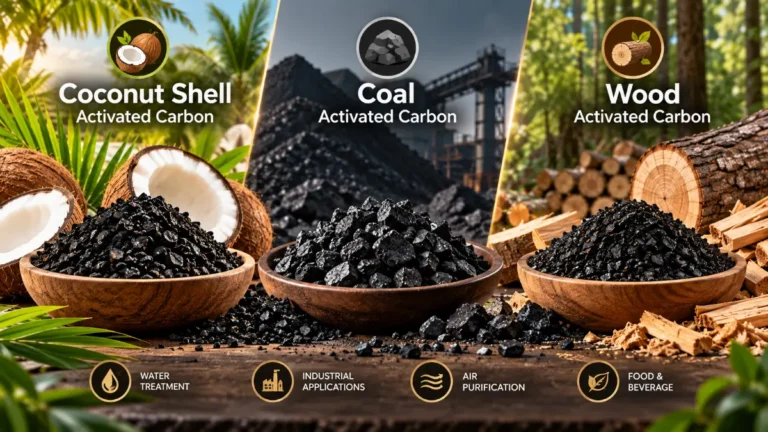
Step 3: Choose the raw material – coal, coconut shell or wood
The raw material shapes the pore structure, and the pore structure decides what the carbon can trap. In simple terms:
- Coal based activated carbon has a wide range of pore sizes. It is a strong, economical all-rounder for municipal water, wastewater and many industrial uses. Our coal based granular grades start at 500 mg/gm iodine value and go up to 1200 mg/gm.
- Coconut shell activated carbon is dominated by very fine micropores. It is the hardest and cleanest of the three, with iodine values from 900 to 1150 mg/gm and minimum hardness of 98%. It is the usual choice for gold recovery and for removing very low levels of trace organics.
- Wood based activated carbon has a more open pore structure that suits larger molecules, especially colour. That is why wood based powder is popular in sugar, edible oil and pharmaceutical decolourisation.
We compare the three in detail in coconut shell vs coal vs wood activated carbon.
Step 4: Read the data sheet like an engineer
Every serious activated carbon manufacturer in India will give you a technical data sheet. The numbers on it are your best tool for comparing offers, as long as you know what they mean:
- Iodine value (mg/gm) – a measure of micropore activity. Higher usually means more capacity for small molecules.
- CTC value – used mainly for gas-phase carbon; shows capacity for vapours.
- Methylene blue value – relevant for colour and larger molecules, especially in powder grades.
- Hardness – how well granules survive backwashing and handling. Low hardness means fines and carbon loss.
- Ash and moisture – lower is generally better; ash can leach into some processes.
- Mesh size – the particle size range, which must match your filter design.
Ask which test method was used (for example ASTM or IS standards). Two numbers measured by different methods are not directly comparable. You can see how we present these values on our coal granular activated carbon data sheet, and our guide on how to read an activated carbon data sheet goes line by line.
Step 5: Insist on a certificate of analysis for every batch
A data sheet tells you what a grade should be. A certificate of analysis (COA) tells you what this particular batch actually is. For bulk buyers, the COA is where consistency is proven.
At Carbon King, every batch is tested to ASTM / IS methods and ships with a COA, so iodine value, hardness, moisture and mesh size are on paper before the goods leave. If you are setting up a long-term supply, ask your supplier to keep the same test methods across shipments so you can track trends over time.
Step 6: Always test a sample first
Even with a perfect data sheet, your water, oil or gas is unique. A sample lets you run a jar test, a small column test or a trial in one filter before you commit to a container. Any confident manufacturer will offer samples. We supply samples before bulk orders, and our team can suggest which two or three grades are worth testing side by side.
What decides the activated carbon price per kg in India?
Buyers often ask for a quick price per kg. The honest answer is that price depends on several things, and a cheap price on the wrong grade is the most expensive option of all. The main price drivers are:
- Raw material – coconut shell grades usually cost more than coal based grades of similar iodine value.
- Activity level – higher iodine or methylene blue values take longer activation and lower yield.
- Mesh size and form – narrow or special mesh cuts and pellets add processing steps.
- Quantity – a full container is priced differently from a trial lot.
- Packing – 25 kg bags, 500 kg or 1 tonne bulk bags, or custom labelling.
- Destination – ex-works, FOB Indian port or delivered to your port changes the number.
The better question is cost per cubic metre of water treated, or per tonne of oil decolourised. A harder, more active carbon can last longer in the bed and lower your total cost even if its price per kg is higher. When you request a quote, share your application and expected volume, and we will price the grade that actually fits.
Packing, MOQ and lead time
For bulk activated carbon supply in India and for export, we pack in bags and bulk bags, with custom packing and labelling on request. Minimum order quantity depends on the grade and packing, and trial quantities can be discussed for new buyers. Lead time and price are shared with your quotation and depend on quantity, packing and destination.
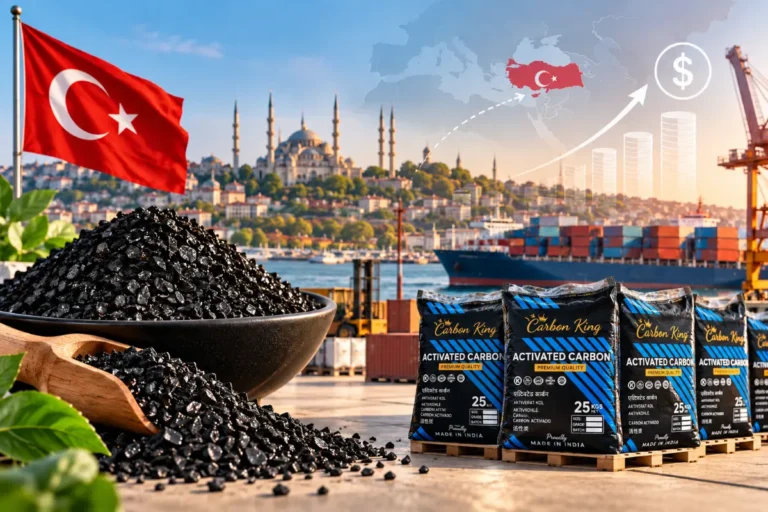
For export orders, goods move by sea in containers, and our team handles the export documents. Buyers in the Gulf can deal directly with our Dubai team; see our activated carbon supplier for the GCC page.
Buying in Kolkata, West Bengal and eastern India
If you are in Kolkata or anywhere in West Bengal, Odisha, Jharkhand or the North-East, you are close to our base. Our India office is in Kolkata and our principal place of business is in Rourkela, Odisha, so buyers in eastern India can talk to a team that knows the region and plan deliveries by road. The process is the same as for any buyer: share the application and quantity, test a sample, then move to regular supply.
A simple checklist before you place your first bulk order
- Have you described the application and contaminant, not just the product name?
- Do you know whether you need granular, powder or pellets?
- Has the supplier suggested a raw material and grade, and explained why?
- Do you have a data sheet with test methods listed?
- Will every batch come with a certificate of analysis?
- Have you tested a sample in your own process?
- Are packing, MOQ, lead time and delivery terms clear in writing?
If you can tick all seven, you are buying activated carbon the way experienced plant engineers do. For more detail on judging suppliers, read how to choose an activated carbon supplier.
Frequently asked questions
Is Carbon King a manufacturer or a trader?
Carbon King manufactures activated carbon and anthracite filter media in India, with coal, coconut shell and wood based grades in granular, powdered and pelletized form.
Do you export activated carbon from India?
Yes. We supply buyers in more than 18 countries, shipping by sea in containers with export documents handled by our team.
Can I get a sample before ordering?
Yes. Samples are available before a bulk order. Tell us your application and the grade you are considering.
Where are your offices?
Our registered office is in Rourkela, Odisha, our India office is in Kolkata, West Bengal, and our international marketing headquarters is in Dubai Silicon Oasis, UAE.
Ready to source activated carbon from India?
Whether you need one trial lot or a yearly contract, the best first step is the same: tell us what the carbon has to do. Visit the Carbon King homepage to see our full range, browse all products, or request a quote and our team will suggest a grade and send a sample.
One Comment